KCTL volunteer engagement app
Kings County Tennis League (KCTL) is a 501(c)(3) non-profit dedicated to providing free tennis instruction and other programming to youth living in and around Brooklyn Public Housing. Like many non-profit organizations, KCTL heavily relies on volunteerism. As a KCTL volunteer of more than 4 years, I identified an opportunity to lend my UX design skills and pilot a volunteer app to improve the volunteer, student, and staff experience.
Currently, KCTL lacks a consistent way of confirming how many volunteers plan to attend a session, which sometimes results in staffing shortages. I hypothesized that a KCTL volunteer app that lets users plan their schedules and communicate availability will improve the overall session experience—for volunteers, students, and staff—by ensuring sufficient coverage for the lessons.
My Role:
To date, I’ve served as the UX designer and researcher from the discovery phase through usability testing. Pending the completion of usability testing, I intend to code a functional MVP with AI and design a pilot.
Approach Summary:
To get started, I reviewed and synthesized existing research related to KCTL volunteerism.
Next, I developed volunteer and staff personas and a current-state user journey map.
I then ideated and sketched initial designs on paper before creating digital wireframes and a clickable prototype in Figma.
Currently, I’m in the process of testing the clickable prototype with KCTL volunteers. This research is intended to help (a) determine whether KCTL volunteers are motivated and willing to use an app to indicate availability ahead of sessions and (b) understand what factors increase or decrease perceived value and adoption.
Throughout the process to date, I leveraged AI to accelerate my design and research workflows. For example, this includes using ChatGPT for the following:
Expanding and summarizing a competitor audit.
Pressure-testing information architecture choices.
Workshopping UX writing for more realistic wireframes.
Summarizing and refining a user research plan and associated discussion guides.
Select Design Process Artifacts
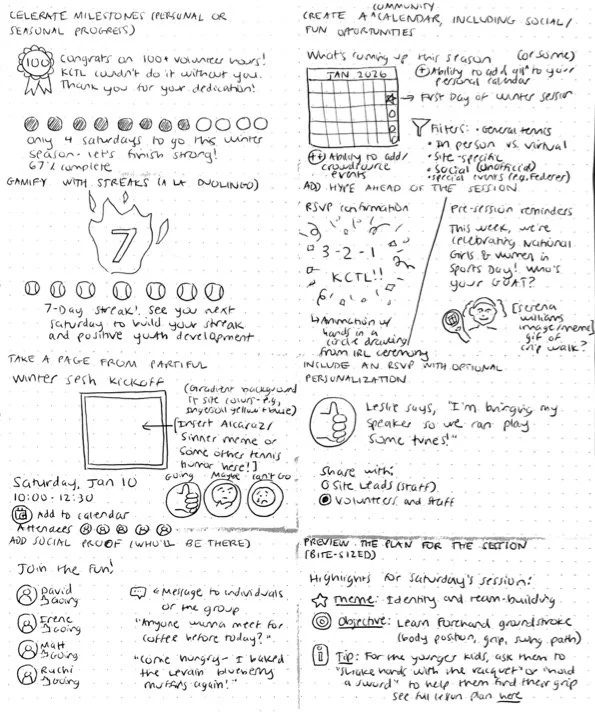
Rapid ideation early in the design sprint, using the “crazy eights” method (1 sketch per minute).
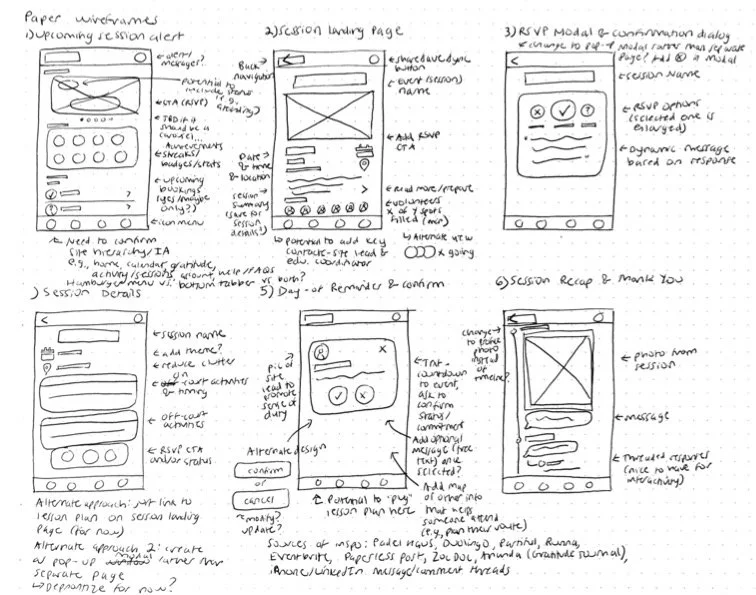
Paper wireframes to conceptualize basic structure and elements, prior to designing in Figma.
Low-fidelity clickable prototype (Figma). Scenario: KCTL has messaged existing volunteers to confirm their attendance and prepare for the upcoming session.
Next Steps:
Complete user interviews with volunteers, then staff.
Incorporate feedback into a high-fidelity prototype and MVP, leveraging AI-assisted coding tools.
Plan potential pilot with a KCTL site. If successful, scale across sites.
What I'm Proud of:
Leveraged my design skills and behavioral science experience to contribute to KCTL in a new and meaningful way, beyond on-court volunteering and fundraising.
Led a participatory design process that engages staff and volunteers at each step and feeds learnings back into the organization.
Helped advance KCTL’s volunteerism-related priorities of getting volunteers more engaged, communicating realtime on-court opportunities, and creating more transparency in attendance, as stated by the Executive Director.